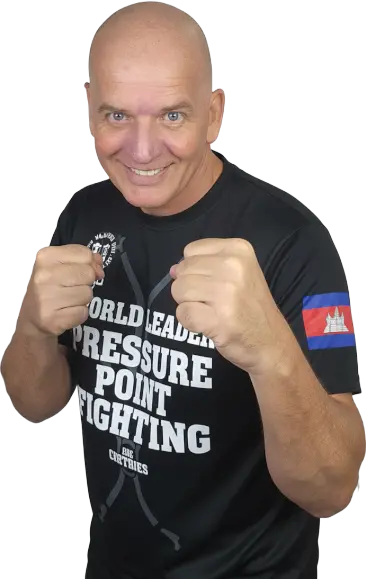
The Complete Guide
What pressure point fighting is, how it really works, whether it works in a real fight, and how to learn it properly. Written by Russell Stutely, after more than 30 years of teaching it to police, fighters and martial artists.
In This Guide
Russell Stutely · 7th Dan · National Boxing Coach, Cambodia
The Short Answer
Pressure point fighting is the skill of striking, pressing or rubbing specific points on the body to stop an attacker quickly. The points are places where nerves run close to the surface, where joints are easy to move the wrong way, or where the body's balance can be taken with very little force.
Instead of relying on size, strength or speed, you use the way the human body is built. Hit the right point at the right angle and an attacker's legs can buckle, his grip can open, his balance can go, or he can be knocked out. That is why over 100 police academies use the defensive tactics system I created: it lets a smaller person control a bigger one, with options from a firm hold right up to a stop.
You will also hear it called kyusho, kyusho jitsu, dim mak or vital point striking. The names come from different traditions, but the idea is the same. My approach strips away the mysticism. There is no "chi" in what I teach — just anatomy, physics and technique that has been tested on the mat, in the ring and on the street.
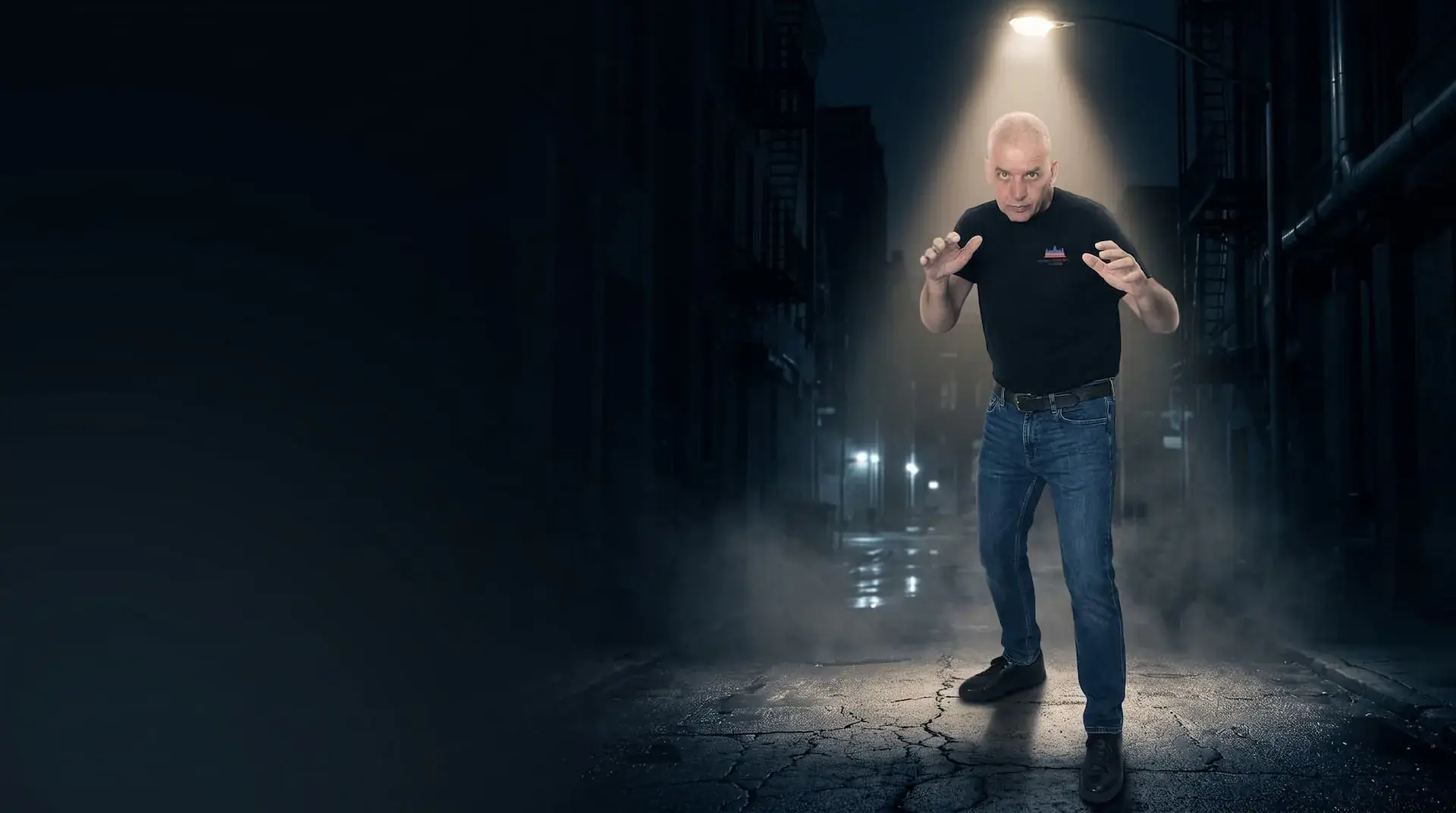
How It Works
Pressure point fighting is not a list of secret spots. It is four skills that work together. These are the same four modules that make up my Pressure Point Fighting Course.
Part 1
Every body has places where a small push, pull or strike takes the balance completely: the feet, knees, elbow, shoulders, hips and head. An attacker who is off balance cannot hit you hard, cannot grab you properly and cannot chase you. Balance comes first, because a point is far easier to hit on someone who is falling.
Part 2
The nerve points themselves: on the head and neck, the torso, the arms and the legs. You learn where each one is, the angle and direction to strike it, and what it does to the person you hit. Some points weaken a limb, some drop the legs, some open a grip and a few can knock someone out.
Part 3
My method of generating real power without size or a big wind-up. A short, relaxed strike that travels through the target does far more than a big, tense swing. Waveforms are what make a pressure point strike work on a resisting, adrenalised attacker instead of a cooperative partner.
Part 4
Opposites, alignment, set-ups and timing: the rules that decide whether a point works. Learn the principles and you can apply pressure points to whatever you already train, whether that is karate, kempo, jiu-jitsu, boxing or police defensive tactics.
Want to see these in action? Watch the five free lessons.
Where To Start
There are hundreds of points on the body, but you only need a handful that work under stress. These five are among the first I teach.
GB-20
In the hollow where the neck muscles meet the base of the skull. Struck at the correct angle it can drop a person instantly, which is why it is the point I demonstrate most often. It is also why it must only ever be trained with great care and control.
ST-5
On the side of the jaw, in front of the angle. This is part of why some punches knock people out and others do not. Boxers who land on it without knowing the name are using a pressure point.
TW-23
At the outer end of the eyebrow. A light, fast strike here affects balance and vision, which makes it a superb set-up point for something bigger.
ST-25
About three finger-widths out to the side of the navel. A short strike here bends an attacker forward and takes the wind out of him, opening the head and neck for the next technique.
SP-6
About four finger-widths above the inside ankle bone. Kicked or stamped, it takes an attacker's base away so he cannot stand his ground. It is one of the lessons in the free mini-course.
Point names follow the standard acupuncture codes (GB = gall bladder, ST = stomach, TW = triple warmer, SP = spleen). They are just a map. What matters is the location, the angle and the direction.
The Honest Answer
Yes, but not the way the internet often shows it. Pressure points are not a magic touch that drops anyone, any time. Anyone who tells you that is selling something. Real people are moving, sweating, wearing clothes and full of adrenaline. Some people react strongly to a point and some hardly react at all.
Pressure points work when they are part of a complete fighting system. First you take the balance. Then you hit the point with real power, at the right angle, as part of a combination. If the point works, the fight is over fast. If it does not, you have still landed a hard, well-aimed strike and you carry on. You never bet everything on one point.
This is exactly how it is taught to police officers. They need control options that work on large, aggressive, non-compliant people, and they need them to work under pressure. Around 20,000 officers a year train with my methods for that reason.
Train Responsibly
Some pressure points can seriously injure or knock someone out. Always train with a qualified instructor or a structured course, with a partner you trust, at low power and with control. Never strike the head or neck at full power in training. In every course I show you how to practise each technique safely.
In self-defence, the law expects your force to be reasonable for the threat you face, and the rules are different from country to country. Pressure point control gives you options that go from a hold all the way up to a stop, which helps you match your force to the threat. I wrote a detailed article on how the courts judge this in self-defence and the law in the UK and the USA.
How To Learn It
Learn at home online, or train with me in person in Cambodia. Wherever you start, every lesson is taught by me, step by step.
Start here
Five free lessons, including ST-25, SP-6, a guillotine, a weapon defence and the waveform front slap. No card needed.
Start FreeThe foundation
43 lessons across balance points, pressure points, waveforms and principles. The course everything else builds on.
View CourseReal self-defence
Three complete courses, Bronze, Silver and Gold, with up to 215 lessons.
View CoursePolice & security
Pressure Point Defensive Tactics at Local, National and International level.
View CourseThe full journey
Blue Belt to National Coach in the Open Circle Fighting Method, over five levels.
View CourseGrow your knowledge
Add pressure points to everything you already know. The store has complete DVD and digital programmes for every kind of student: kata bunkai, boxing, police defensive tactics, power striking, self-defence for older fighters and my most advanced pressure point material. Hard copies ship free worldwide.
Visit The StorePrefer to learn face to face? See private mentoring, training camps and seminars and group training.

About The Author
I have taught pressure point fighting and real self-defence for over 30 years. I created Pressure Point Defensive Tactics (PPDT), now used at over 100 police academies, and the Open Circle Fighting Method. I am the National Boxing Coach for Cambodia, where I live and train in Siem Reap.
Questions
Five free video lessons from the courses I teach. Create a free account and start watching in the next few minutes. No card required.